The new Retirement Plan Contribution Limits are official!

The following limits are going up for 2026:

·         Maximum contributions for 401(k), 403(b) and 457 increased to $24,500

·         Maximum contributions for SIMPLE retirement accounts increased to $17,000

·         Maximum contributions for Defined Contribution Limit increased to $72,000

·         Super Catch-up for Age 60-63 remained the same at $11,250

Review the full list of contribution limit changes below and share with your plan participants!

CTA: 2026 Contribution Limits


CURTIS S. FARRELL, CFP®, AIF®
949.455.0300 x222
cfarrell@fmncc.com

ARAN SAHAGUN, CRPS®
949.455.0300 x210
asahagun@fmncc.com

Investment advisory services are offered by Financial Management Network, Inc. (“FMN”) and securities offered through FMN Capital Corporation, (“FMNCC”), member FINRA & SIPC. 

This information was developed as a general guide to educate plan sponsors and is not intended as authoritative guidance or tax/legal advice. Each plan has unique requirements, and you should consult your attorney or tax advisor for guidance on your specific situation.

©401(k) Marketing, LLC.  All rights reserved. Proprietary and confidential.  Do not copy or distribute outside original intent.

Is Your Retirement Plan Ready for Today's Cybersecurity Threats?

Practical steps to help protect participants' data and meet your fiduciary duties.

 As a retirement plan sponsor, you are juggling plenty of responsibilities. Investment oversight, fee monitoring, participant education… the list goes on. Now there's another item on your priority list: cybersecurity.

If you're thinking "cybersecurity is an IT issue," you're not alone. Many plan sponsors assume data protection falls outside their wheelhouse. But when it comes to your 401(k) plan, cybersecurity is very much a fiduciary responsibility, and it's one that can have serious consequences if you don't address it properly.

Why cybercriminals target retirement plans

Retirement plans contain exactly the type of information cybercriminals value most. Think about the sensitive information stored in your plan's database:

·        Social Security numbers

·         Birthdates

·         Salary information

·         Account balances

·         Beneficiary details

This treasure trove of personal and financial data represents a one-stop shop for identity theft and financial fraud.

The substantial assets held in retirement accounts also make them attractive targets. With the average 401(k) balance continuing to grow, and many accounts holding six-figure sums, the potential payoff for successful cyberattacks keeps increasing.

What the Department of Labor expects

The DOL has made it clear that cybersecurity falls squarely within plan sponsors' fiduciary duties. The agency's updated 2024 guidance confirms that all ERISA plans must have appropriate cybersecurity measures in place to protect participants and beneficiaries from cybercrimes.

This means that plan sponsors must exercise the same level of prudent oversight for cybersecurity as they do for investment selection and fee monitoring. Plan sponsor compliance isn't just checking boxes; it's demonstrating that you're taking reasonable steps to protect participant information and plan assets.

Building your cybersecurity foundation

The good news is that effective cybersecurity doesn't require you to become a technical expert. It does, however, require a systematic approach and attention to key areas that can significantly reduce your risk.

·         Protect data. Encrypt participant information and require multi-factor authentication.

·         Train employees. Teach them to spot phishing, use strong passwords, and report issues.

·         Plan for incidents. Have a response plan to minimize damage and show your commitment to
safeguarding participant data.

Monitor service providers carefully

Most plan sponsors rely on recordkeepers, payroll companies, TPAs, and other providers. Since these vendors have access to participant data, their cybersecurity practices directly affect your plan's exposure to potential risks.

When choosing a vendor, ask specific questions. Check their security measures, certifications, and incident handling. Don't hesitate to ask the tough questions; your fiduciary duty requires this level of due diligence.

Keep tabs on your providers' security through regular updates and audit report reviews to help confirm they have proper protections in place. Make sure your service contracts include clearly- defined cybersecurity requirements and detailed notification procedures for any security incidents.

Developing your cybersecurity policy

A well-documented cybersecurity policy provides detailed guidance for employees, demonstrates your commitment to data protection, and can be valuable evidence of prudent fiduciary oversight.

Your cybersecurity policy should include these essential action components:

•          Define what constitutes sensitive plan data and how it should be handled.

•          Specify who can access plan systems and under what circumstances.

•          Outline mandatory cybersecurity training and ongoing education.

•          Establish minimum security requirements for all service providers.

•          Detail steps to take when a security incident occurs.

•          Schedule periodic reviews and security updates.

Creating a culture of cybersecurity awareness

Effective cybersecurity requires buy-in from your entire organization, not just the IT department. Leadership support demonstrates the importance of data protection and helps allocate resources for security initiatives.

Regular communication about cybersecurity threats and best practices helps to promote security awareness.

·         Send reminders about common threats.

·         Recognize employees who report suspicious activity.

·         Update staff on new security measures.

 When cybersecurity becomes part of your culture, your potential risks decline significantly.

Taking the next step

Implementing cybersecurity measures and staying current with evolving regulatory requirements may seem daunting, but keep in mind that you don't have to go it alone. Many plan sponsors find that working with experienced advisors and cybersecurity professionals helps them to develop appropriate protection measures without getting overwhelmed by technical details.

Start by honestly assessing your current cybersecurity practices. Review your existing policies, evaluate your service providers' security measures, and identify any obvious gaps in protection.


CURTIS S. FARRELL, CFP®, AIF®
949.455.0300 x222
cfarrell@fmncc.com

ARAN SAHAGUN, CRPS®
949.455.0300 x210
asahagun@fmncc.com

Investment advisory services are offered by Financial Management Network, Inc. (“FMN”) and securities offered through FMN Capital Corporation, (“FMNCC”), member FINRA & SIPC. 

This information is provided as a general guide to educate plan sponsors. It is not intended as authoritative guidance or tax/legal advice. Each plan has unique requirements, and you should consult your attorney or tax advisor for guidance on your specific situation.

This information is provided as a general guide to educate plan sponsors. It is not intended as authoritative guidance or tax/legal advice. Each plan has unique requirements, and you should consult your attorney or tax advisor for guidance on your specific situation.

©401(k) Marketing, LLC. All rights reserved. Proprietary and confidential. Do not copy or distribute without permission.

Employee Education: Retirement Transition Planning

Retirement Transition: More Than Just Finances

Retirement is more than just a financial decision; it’s a major life transition. This presentation explores how to prepare emotionally and practically, covering purpose, connection, structure, and planning. The goal is to have real conversations around the emotional impact this major life transition can have on you, so that you are more prepared.

CTA: Watch the Video

This short video discusses 5 key action areas:

• Understand emotional changes and normalize the transition process.

• Reframe your identity and explore new passions post-career.

• Discover the importance of social relationships and how to stay meaningfully connected.

• Build a personalized rhythm of activities that align with your motivation style.

• Combine financial discussions with lifestyle goals to create a cohesive retirement plan.

You can also download this practical guide to help yourself or others prepare for retirement by focusing on the emotional and lifestyle aspects of the transition, and not just finances. It includes prompts and tools to support self-reflection, connection, purpose, structure, and aligning daily life with long-term goals.

Designed to empower near retirees with clarity and confidence, it complements financial planning with personal readiness.

CTA: Download Retirement Transition - Navigating Change with Confidence

Benefits of Financial Education

• For employees: Better planning leads to less stress, more focus, and increased financial
confidence.

• For employers: When employees are financially-educated and equipped to retire on time, the
company benefits from a happier, more engaged, and better prepared workforce.

Looking for More Employee Education?

Supporting teams with ongoing education builds morale and engagement. Contact us to explore ways to keep employees connected with valuable resources.


CURTIS S. FARRELL, CFP®, AIF®
949.455.0300 x222
cfarrell@fmncc.com

ARAN SAHAGUN, CRPS®
949.455.0300 x210
asahagun@fmncc.com

Investment advisory services are offered by Financial Management Network, Inc. (“FMN”) and securities offered through FMN Capital Corporation, (“FMNCC”), member FINRA & SIPC. 

This information is provided as a general guide to educate plan sponsors. It is not intended as authoritative guidance or tax/legal advice. Each plan has unique requirements, and you should consult your attorney or tax advisor for guidance on your specific situation.

This information was developed as a general guide to educate plan sponsors and is not intended as authoritative guidance or tax/legal advice. Each plan has unique requirements, and you should consult your attorney or tax advisor for guidance on your specific situation.

©401(k) Marketing, LLC.  All rights reserved. Proprietary and confidential.  Do not copy or distribute outside original intent.

Protecting Your Employees from Bad Financial Advice

Why human-led employee education still matters

 It’s wonderful to live in a time when answers are just a click away. You can easily find out how many inches are in a meter, get TV show recommendations, and find out where the next Olympic Games will happen. But when it comes to financial advice, the internet becomes a far riskier place.

From TikTok tips to viral Reddit threads, employees are consuming an overwhelming amount of financial content, and not all of it is accurate. In fact, much of it can be misleading, incomplete, or flat-out wrong. And while younger generations are the most likely to seek out this digital advice, they’re also the most vulnerable to its consequences.

Online financial information is popular

Social media platforms and influencer content are not inherently bad, but they are unregulated. Anyone with a camera and confidence can offer "advice" without any credentials. This opens the door to the kind of misinformation that can lead employees to make costly mistakes.

It’s especially concerning for younger employees. A recent survey found that 49% of Gen Z and 43% of millennials have sought financial advice on social media. Top sources for digital advice are Facebook, Instagram, TikTok, Twitter/X, and financial influencers from other platforms.1 This may makes them more susceptible to making costly financial decisions, such as buying into trendy “get rich quick” schemes, misusing credit, or delaying critical savings milestones like retirement contributions.

The drawbacks of online financial advice

While it’s easy and convenient to look online for financial advice, the information found may be incomplete, misleading, or inaccurate.

“While some platforms have added disclaimers or warning labels on financial advice content…the risk of making misguided investment decisions due to misinformation and fraud is greater than the risk would be if the advice was taken from traditional advice channels. In the first six months of 2023, the Federal Trade Commission reported losses totaling $2.7 billion from investment-related fraudulent scams initiated on social media in the US alone; 37% of those fraud losses were reported by investors aged 20-29,” explained the World Economic Forum. [1]

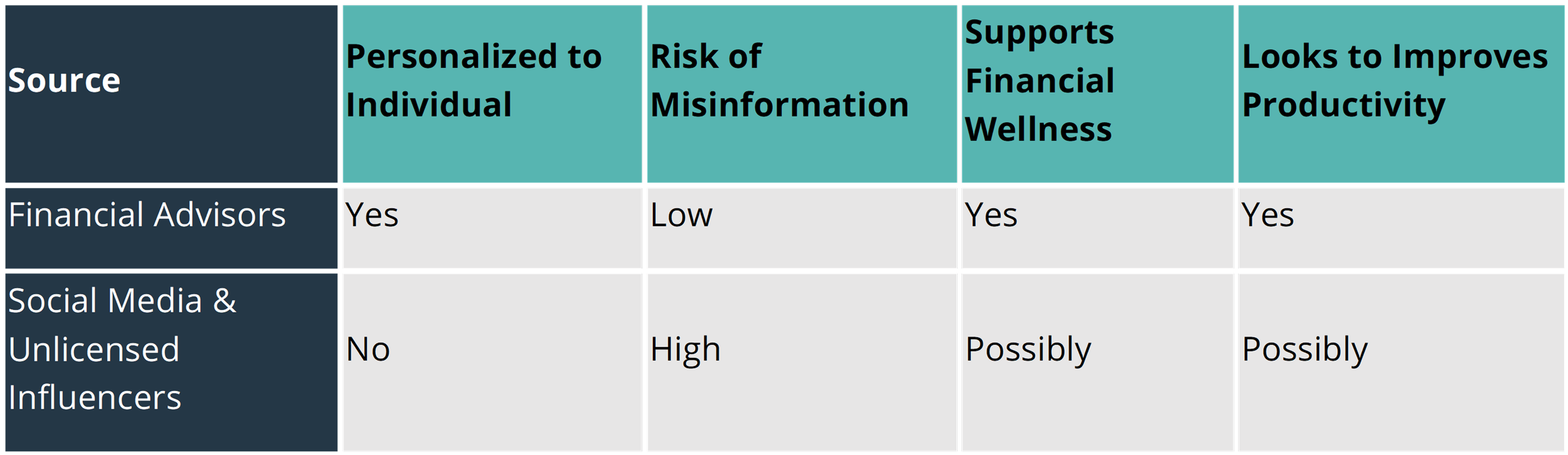
When your employees receive and act on poor financial information, it can have a detrimental effect on financial wellness. Workers who are financially stressed may become less engaged and less productive – and that can hurt employers.

 Pros and Cons of Financial Education Sources

The advantages of in-person employee education

While employees will continue to seek advice online, it’s possible to help them avoid costly errors by offering in-person financial education at work. A licensed financial professional can engage employees through group meetings or one-on-one sessions. Either possibility will give employees opportunities to:

·         Receive personalized financial education from a licensed professional

·         Double-check the accuracy and applicability of advice they’ve found online

·         Choose saving strategies that reflect their personal finances and goals

·         Build financial confidence while improving their financial security

When employers want to deliver financial education that supports financial wellness and retirement outcomes, partnering with a retirement plan advisor makes a real difference. Advisors can deliver robust financial education programs and fill education gaps with tailored, relatable content that can improve employee decision-making and overall financial wellness.

If you would like a complimentary consultation or a demonstration of our services, please get in touch. We are experienced employee educators who understand the importance of financial wellness.

[1] Aru Bhat and Sofia Eckrich. “Are 'finfluencers' the future of financial advice?” World Economic Forum. July 17, 2024. Cited June 27, 2025.


CURTIS S. FARRELL, CFP®, AIF®
949.455.0300 x222
cfarrell@fmncc.com

ARAN SAHAGUN, CRPS®
949.455.0300 x210
asahagun@fmncc.com

Investment advisory services are offered by Financial Management Network, Inc. (“FMN”) and securities offered through FMN Capital Corporation, (“FMNCC”), member FINRA & SIPC. 

This information is provided as a general guide to educate plan sponsors. It is not intended as authoritative guidance or tax/legal advice. Each plan has unique requirements, and you should consult your attorney or tax advisor for guidance on your specific situation.

©401(k) Marketing, LLC. All rights reserved. Proprietary and confidential. Do not copy or distribute without permission.

Plan Sponsor Guide: Checklist for Keeping Participants Informed

Want fewer questions and better outcomes during plan changes? Start with clear, step-by-step communication.

A strong participant communication checklist helps plan sponsors share plan updates clearly, confidently, and on time. When your retirement plan changes, knowing how and when to communicate is essential.

From legal notices to plain-language updates, plan sponsors have a lot to manage. Participants need accurate, timely information to understand what’s changing and how it will affect them.

That’s why this checklist focuses on helping you:

●        Identify what’s changing and who it impacts

●        Coordinate messaging with your providers

●        Choose the right delivery methods

●        Create clear, participant-friendly messages

●        Track follow-up and questions after rollout

Good communication builds trust. It also supports your fiduciary responsibilities and helps employees stay engaged with their retirement benefits.

If your plan has updates coming soon, or you want to strengthen your communication process, this checklist is a simple, valuable place to start.

CTA: Download the checklist to help streamline your next plan communication.


CURTIS S. FARRELL, CFP®, AIF®
949.455.0300 x222
cfarrell@fmncc.com

ARAN SAHAGUN, CRPS®
949.455.0300 x210
asahagun@fmncc.com

Investment advisory services are offered by Financial Management Network, Inc. (“FMN”) and securities offered through FMN Capital Corporation, (“FMNCC”), member FINRA & SIPC. 

This information was developed as a general guide to educate plan sponsors and is not intended as authoritative guidance or tax/legal advice. Each plan has unique requirements, and you should consult your attorney or tax advisor for guidance on your specific situation.

©401(k) Marketing, LLC.  All rights reserved. Proprietary and confidential. Do not copy or distribute outside original intent.

Plan Sponsor Guide: Checklist for Keeping Participants Informed (Copy)

Want fewer questions and better outcomes during plan changes? Start with clear, step-by-step communication.

A strong participant communication checklist helps plan sponsors share plan updates clearly, confidently, and on time. When your retirement plan changes, knowing how and when to communicate is essential.

From legal notices to plain-language updates, plan sponsors have a lot to manage. Participants need accurate, timely information to understand what’s changing and how it will affect them.

That’s why this checklist focuses on helping you:

●        Identify what’s changing and who it impacts

●        Coordinate messaging with your providers

●        Choose the right delivery methods

●        Create clear, participant-friendly messages

●        Track follow-up and questions after rollout

Good communication builds trust. It also supports your fiduciary responsibilities and helps employees stay engaged with their retirement benefits.

If your plan has updates coming soon, or you want to strengthen your communication process, this checklist is a simple, valuable place to start.

CTA: Download the checklist to help streamline your next plan communication.

5 Advanced Tax Strategies for Employers

Elevating the value of your retirement plan

 Imagine this: It’s year-end and your CPA just reviewed your projected tax bill. Despite contributing to your 401(k), maximizing deductions, and running a profitable business, you're still writing a sizable check to the IRS. You pause and think, there has to be a better way.

If this sounds familiar, you’re not alone. Many high-income business owners, CFOs, and executives find themselves hitting the ceiling of traditional planning, maxing out the basics while still exposed to significant state and federal tax burdens that erode long-term wealth.

The solution? Transform your company-sponsored retirement plan into a tax-smart, strategic tool. By applying advanced tax strategies, you can elevate your plan from a standard benefit into a strategy for wealth accumulation and executive retention. If you already sponsor a 401(k) plan, you’ve laid the foundation. But unlocking its full potential, especially for high earners, requires advanced plan design.

Whether your company has a new plan or $500 million in plan assets, strategic enhancements can help you defer significantly more income, reduce taxable income, and reinvest back into your people and your own future.

1. Profit-sharing and tiered allocations

Most plans include matching contributions, but there’s significantly more opportunity when you integrate a profit-sharing component. With the right allocation formula, such as New Comparability or Age-Weighted methods, you can direct larger contributions to key executives while satisfying compliance testing.

According to the Voice of the American Workplace 2025 study by Franklin Templeton, 41% of employers already offer profit-sharing and 66% offer a 401(k) match, with the average match capping at 25% of employee contributions.[1] How does your plan compare?

With this structure, high-income earners could realize up to $70,000 (or $77,500 for ages 50–59 or 64+, $81,250 for ages 60–63, if your plan allows) is available in total annual contributions including employee deferrals, catch-up contributions, employer match, and profit-sharing, significantly more than what a standard employee can defer, all while reducing taxable income.

2. Cash balance plans

If your company has strong cash flow and steady profits, a Cash Balance Plan can take your retirement and tax strategy to the next level.

When paired with a 401(k), it allows much higher contribution limits, often over $300,000 per year, depending on the owner’s age and income. All contributions are tax-deductible to the business, making it a smart way to reduce taxable income while building long-term wealth.

Cash Balance Plans are especially effective for:

·         Owners and executives over age 45 looking to catch up quickly on retirement savings

·         Professional service firms (law, medical, consulting)

·         Closely held companies or businesses with few highly compensated employees


3. Executive incentives & retention tools

Today’s top talent, especially in leadership roles, expects more than a simple match. Advanced plans can offer:

·         Deferred compensation programs: Allow select employees to postpone a portion of income and
taxes to a future date, often used to retain key executives through vesting schedules or
performance benchmarks.

·         Discretionary profit-sharing schedules: Let employers allocate variable, performance-tied
contributions at year-end, ideal for rewarding leadership in profitable years without locking into
fixed obligations.

·         Megaback door Roth contributions: Enable after-tax contributions to a 401(k) beyond
traditional deferral limits, which can then be converted to Roth, either in-plan or via rollover. This
strategy allows high earners who've maxed out traditional Roth or pretax contributions to
achieve additional tax-advantaged savings and diversify future tax exposure.

4. Tax strategies and plan structure alignment

If you operate as an S-Corp or partnership, every dollar you contribute for owners and key employees not only reduces corporate taxable income; it often lowers pass-through income, impacting individual taxes as well. Layering tax-deductible contributions into the right structure helps balance short-term tax savings with long-term wealth building.

5. Don't leave optimization on the table

If it’s been more than a year since your plan design was reviewed, you may be leaving value on the table. Today’s optimized plans are:

·         Cost-efficient

·         Optimized for tax strategy

·         Aligned with generational employee needs

·         Built for long-term retention

Make the most of what you already offer

You’ve already invested in your 401(k) plan. Now’s the time to confirm it’s working just as hard as you are, helping you defer more income, retain your top people, and reduce tax exposure along the way.

Talk to us about profit-sharing modeling, cash balance plan layering, and owner-weighted strategies that help to deliver maximum value.

 ________________________________________

[1] Franklin Templeton. “Voice of the American Workplace.” 2025.

CURTIS S. FARRELL, CFP®, AIF®
949.455.0300 x222
cfarrell@fmncc.com   

ARAN SAHAGUN, CRPS®
949.455.0300 x210
asahagun@fmncc.com


Investment advisory services are offered by Financial Management Network, Inc. (“FMN”) and securities offered through FMN Capital Corporation, (“FMNCC”), member FINRA & SIPC. 

This information is provided as a general guide to educate plan sponsors. It is not intended as authoritative guidance or tax/legal advice. Each plan has unique requirements, and you should consult your attorney or tax advisor for guidance on your specific situation.

©401(k) Marketing, LLC. All rights reserved. Proprietary and confidential. Do not copy or distribute without permission.

News and Information for Employers: Plan Design Considerations

Retirement plan rules are changing, and we are here to keep you informed and updated. Here's what you need to know:

• Plan Provisions & SECURE Act 2.0: Automatic enrollment, Roth options, student loan matching,
and more. Is your plan designed for today’s workforce?

• Retirement Readiness: Employees need simple, helpful education to make confident choices.
How to utilize pre-retiree education to support their journey.

• Forfeitures, Missing Participants, & Force-Outs: Unvested dollars, outdated contact info, and
small accounts can drag your plan down. A quick checklist to clean things up!

CTA: Plan Design Considerations Newsletter


CURTIS S. FARRELL, CFP®, AIF®
949.455.0300 x222
cfarrell@fmncc.com

ARAN SAHAGUN, CRPS®
949.455.0300 x210
asahagun@fmncc.com

Investment advisory services are offered by Financial Management Network, Inc. (“FMN”) and securities offered through FMN Capital Corporation, (“FMNCC”), member FINRA & SIPC. 

This information is provided as a general guide to educate plan sponsors. It is not intended as authoritative guidance or tax/legal advice. Each plan has unique requirements, and you should consult your attorney or tax advisor for guidance on your specific situation.

©401(k) Marketing, LLC. All rights reserved. Proprietary and confidential. Do not copy or distribute without permission.

Americans Are Retiring Later: Here’s Why

Employers can help improve retirement readiness, so workers retire on time.

More workers are planning to retire at 70—or never. This could impact your workplace. What’s holding them back?

• High savings goals

• Debt and other financial stressors

• Healthcare concerns

• Anxiety about leaving work

The good news? You can help them feel more ready for retirement by providing helpful education, promoting catch-up savings options, sharing practical healthcare strategies, and offering phased retirement options.

CTA: Check out our guide here

Let’s chat if you’d like to talk more!


CURTIS S. FARRELL, CFP®, AIF®
949.455.0300 x222
cfarrell@fmncc.com

ARAN SAHAGUN, CRPS®
949.455.0300 x210
asahagun@fmncc.com

Investment advisory services are offered by Financial Management Network, Inc. (“FMN”) and securities offered through FMN Capital Corporation, (“FMNCC”), member FINRA & SIPC. 

This information is provided as a general guide to educate plan sponsors. It is not intended as authoritative guidance or tax/legal advice. Each plan has unique requirements, and you should consult your attorney or tax advisor for guidance on your specific situation.

©401(k) Marketing, LLC. All rights reserved. Proprietary and confidential. Do not copy or distribute without permission.

3 Plan Health Essentials: Forfeitures, Missing Participants, and Force-Outs

A strategic look at your 401(k) plan’s health

Ever looked at your company’s 401(k) plan and spotted the name of an old colleague?

It takes you down memory lane—you pause and think, “I wonder how they’re doing?”

That familiar name may trigger a harmless moment of nostalgia. But it could be a signal for something bigger. It might point to a missing participant, an untouched forfeiture, or an opportunity to clean up your plan and uncover hidden value.

As a business leader, you know that small details matter. They can directly impact operational costs, reduce audit exposure, and strengthen overall plan health. Three key areas—forfeitures, missing participants, and force-outs—are often missed but can make a big difference.

1. Forfeitures: unlocking hidden plan assets
When an employee leaves before becoming fully vested in their retirement account, the unvested employer contributions don’t vanish. They’re moved into a forfeiture account. These funds can be a valuable resource if used properly and in accordance with the plan document.

Forfeiture funds can be used to:

·         Pay allowable plan administrative expenses

·         Offset future employer contributions

·         Be reallocated as additional employer contributions to active participants

Many plans unknowingly let these dollars sit idle, or worse, don’t use them within the required timeframe (generally by the end of the current plan year or the following year). This not only risks non-compliance but also leaves budget-saving opportunities on the table.

Tip: Review your plan document and forfeiture balances with your service provider. If there’s money sitting in the account, put it to work—it's already yours.

2. Missing participants: a silent threat to plan integrity

Missing participants are former employees who still have money in the plan, but their contact information is outdated or unknown. Even though they’re no longer active, they still count toward total plan participants, which can have consequences.

Here’s why it matters:

·         Plans with 100+ account balances require an annual audit

·         You may continue sending costly required notices

·         You expose the plan to fiduciary and regulatory risk

The Department of Labor (DOL) has published guidance on how to find these individuals, including:

·         Conducting address searches

·         Sending certified mail

·         Contacting emergency or plan-designated contacts

·         Keeping documentation of all efforts

Tip: Build a process for updating participant information regularly. Clean participant data can help you avoid unnecessary audits and strengthen fiduciary governance.

3. Force-outs: a smart way to streamline

Force-outs, also called involuntary cash-outs, allow plan sponsors to remove small account balances for terminated employees. Under $1,000? The participant can typically be cashed out. Between $1,000–$7,000? Consider setting up a Safe Harbor IRA provision through your recordkeeper.

This approach helps:

·         Reduce total participant count

·         Lower administrative burden

·         Limit fiduciary risk tied to abandoned accounts

It demonstrates that you’re actively managing your plan, which can be helpful in the event of a DOL or IRS inquiry.

Tip: Work with your TPA or recordkeeper to review and implement force-out procedures. Even one or two distributions per year can make a big difference over time.

Keeping your plan clean pays off

When it comes to managing your company’s retirement plan, a little housekeeping goes a long way. Monitoring forfeitures, missing participants, and small-balance force-outs isn’t just busywork, it’s smart plan stewardship.

These simple actions can:

·         Free up unused funds

·         Reduce audit risk and costs

·         Improve data integrity

·         Reinforce your fiduciary duty

If it’s been a while since you’ve cleaned up your plan records, now’s a great time to take a closer look. That old coworker’s name on your report? It might just be the start of some extra savings and better plan health.


CURTIS S. FARRELL, CFP®, AIF®
949.455.0300 x222
cfarrell@fmncc.com

ARAN SAHAGUN, CRPS®
949.455.0300 x210
asahagun@fmncc.com

Investment advisory services are offered by Financial Management Network, Inc. (“FMN”) and securities offered through FMN Capital Corporation, (“FMNCC”), member FINRA & SIPC. 

This information is provided as a general guide to educate plan sponsors. It is not intended as authoritative guidance or tax/legal advice. Each plan has unique requirements, and you should consult your attorney or tax advisor for guidance on your specific situation.

©401(k) Marketing, LLC. All rights reserved. Proprietary and confidential. Do not copy or distribute without permission.

Retirement Readiness Starts Now: Helping Employees Plan with Confidence

Practical ways employers can support their workforce’s financial future

Many Americans are thinking seriously about their financial future—and with good reason. The economy and rising cost of living have left people feeling uncertain about what lies ahead.

Recent research from the 2025 Transamerica Retirement Survey [1] offers a clearer picture of what today’s workforce is facing:

  • Half of workers report that they haven’t saved enough to retire.

  • 73% of workers say they are confident they’ll be able to retire comfortably—but only 24% feel very confident.

  • 22% plan to retire later than expected.

  • The median household retirement savings is just $93,000.

These numbers show that while many workers are thinking about retirement, most still need help getting—and staying—on track.

An opportunity for employers

This shift in mindset creates a meaningful opportunity for employers. A strong retirement education program can meet employees where they are. Programs that offer accessible tools and supportive guidance can help build financial confidence.

Covering topics such as financial wellness, healthcare, and retirement planning makes these programs more relevant and helpful to your team. With relevant resources, employees can move from uncertainty to action—one step at a time.

Supporting early preparation

Starting early can make a big difference when it comes to retirement. Many employers are helping by offering education, planning tools, and easy ways to start saving.

Employees often have a lot on their plates: paying bills, managing debt, and covering everyday costs can take priority. But with the right support, many are finding ways to balance short-term needs with long-term goals. Features like auto-enrollment and auto-escalation can make it even easier to get started.

Planning for retirement involves important decisions. People want to know how much to save, when to claim Social Security, and how to turn savings into income. That can feel like a lot, but with simple resources and helpful guidance, it’s easier to confidently take the next step.

Retirement readiness education

Employees need clear, helpful retirement education and easy-to-use planning tools. The following best practices can make your education program more effective:

·    Offer targeted and ongoing education. People want information that helps solve real problems.
Since employees face different challenges, targeted messages for different groups can work
well. It's also helpful to offer education often, so that new employees or those with changing
needs can stay informed.

·     Use adult learning principles. Adults want to know why something matters before they engage.
They are more likely to learn when the content is useful and focused on solutions.

·     Share information in different ways. Everyone learns a little differently. Education can be shared
in short messages like emails, posters, or videos. It can also be offered through longer formats
like webinars, one-on-one sessions, or recorded presentations.

·     Keep it simple. Use straight-forward language and avoid jargon. The easier the message is to
follow, the more likely employees are to use the information.

·     Make it relevant. Tailor your education program to fit your company. Include details about your
plan, plus helpful topics like investing, risk and reward, asset allocation, and the value of long-
erm planning.

·     Include ways to interact. People remember more when they use what they’ve learned. Add
activities or short breaks that let employees think through the material and apply it.

A path forward

Retirement planning is a journey. Employees need guidance, support, and tools they can trust along the way. When employers offer thoughtful education programs—built around real-life needs and clear communication—they help remove uncertainty and encourage action.

By making retirement readiness a priority, you’re not just helping your employees plan for their future; you’re also creating a stronger, more confident workforce today.

[1] Collinson, Catherine, et al. “Retirement in the USA: The Outlook of the Workforce.” Transamerica Institute. Mar. 2025.


CURTIS S. FARRELL, CFP®, AIF®
949.455.0300 x222
cfarrell@fmncc.com

ARAN SAHAGUN, CRPS®
949.455.0300 x210
asahagun@fmncc.com

Investment advisory services are offered by Financial Management Network, Inc. (“FMN”) and securities offered through FMN Capital Corporation, (“FMNCC”), member FINRA & SIPC. 

This information is provided as a general guide to educate plan sponsors. It is not intended as authoritative guidance or tax/legal advice. Each plan has unique requirements, and you should consult your attorney or tax advisor for guidance on your specific situation.

©401(k) Marketing, LLC. All rights reserved. Proprietary and confidential. Do not copy or distribute without permission.

Employee Education: Pre-retirement Savings Guide

Smart strategies to optimize your retirement savings and prepare for what’s ahead

Retirement might feel far away or right around the corner—but either way, it’s important to be prepared! The new Pre-retirement Savings Guide and on-demand video are here to help you make confident choices.

CTA: Watch the Video

What you’ll learn:

·         Saving benchmarks to help you see if your savings are on track

·         Social Security tips for making the most of your benefits

·         Medicare breakdowns to help avoid surprises

·         Smart strategies for boosting your savings

You can also download the corresponding worksheet to help you feel more prepared for your next chapter.

CTA: Download Pre-retirement Savings Guide

Benefits of Financial Education

·         For employees: Better planning leads to less stress, more focus, and increased financial
confidence.

·         For employers: Financially-educated teams are happier, more engaged, and better prepared
for the future. When employees are equipped to retire on time, organizations can reduce the
rising costs associated with delayed retirement—such as higher healthcare expenses and
lower workforce transitions.

Looking for More Employee Education?

Supporting teams with ongoing education builds morale and engagement. Contact us to explore ways to keep employees connected with valuable resources.


CURTIS S. FARRELL, CFP®, AIF®
949.455.0300 x222
cfarrell@fmncc.com


ARAN SAHAGUN, CRPS®
949.455.0300 x210
asahagun@fmncc.com


Investment advisory services are offered by Financial Management Network, Inc. (“FMN”) and securities offered through FMN Capital Corporation, (“FMNCC”), member FINRA & SIPC. 

This information is provided as a general guide to educate plan sponsors. It is not intended as authoritative guidance or tax/legal advice. Each plan has unique requirements, and you should consult your attorney or tax advisor for guidance on your specific situation.

©401(k) Marketing, LLC. All rights reserved. Proprietary and confidential. Do not copy or distribute without permission.

6 Trending Plan Provisions: What’s New and What to Know

Understand the pros, cons, and considerations for moving forward

 It started with a simple question during a leadership meeting:

"What’s in our 401(k) plan—and are plan provisions still working for our team the way they should?"

The CEO glanced around the room. No one had a clear answer. The plan had been in place for years, maybe even decades. It quietly ran in the background while the company grew. But things had changed. New hires were asking about Roth options. Long-time employees were thinking about their retirement around the corner. And recent headlines about SECURE Act 2.0 raised more questions. It was clear the time had come to take a closer look.

This scenario is playing out in boardrooms across the country. Retirement plans—once seen as “set it and forget it”—are now under the spotlight. Rules are changing. Teams are growing more diverse. And there’s a bigger focus on financial health. Many plan sponsors are asking: Is our plan still a good fit?

A deeper look into plan provisions

Whether you're a CEO, CFO, HR leader, or plan fiduciary, it’s important to understand your plan provisions and what updates might help. Today’s 401(k) plans offer more options than ever before. Features like automatic enrollment, student loan matching, and Roth conversions are gaining attention. Each plan provision brings unique pros, cons, and considerations.

Let’s take a closer look at the options shaping modern retirement plans and how to evaluate the right ones for your workforce.

1.      Automatic enrollment and escalation

· PRO: Automatic enrollment helps new employees start saving immediately, boosting
participation rates. Automatic escalation slowly increases contribution rates over time. Both
help employees save more without requiring them to take action.

· CON: Higher participation may lead to increased employer match costs. Some employees may
opt out if not fully educated on the benefits.

·      CONSIDERATION: SECURE Act 2.0 mandates auto-enrollment (starting at 3% and escalating
annually by 1% up to 10-15%) for most new 401(k) plans beginning in 2025. Now is a good time to
evaluate if your current plan includes this feature or if it should.

2.     After-tax contributions and Roth conversions

·       PRO: Allows high earners to save beyond the traditional deferral limits. After-tax contributions
can be converted to Roth at a later time, offering potential tax-free growth.

·       CON: Adds administrative complexity and may confuse employees, especially if they are
unfamiliar with the nuances of after-tax vs. Roth.

·       CONSIDERATION: If your team values tax flexibility, these plan provisions may be worth adding.
They’re especially helpful for high earners or younger employees focused on long-term growth.

3.     Student loan matching

·       PRO: Helps younger employees balance debt repayment and retirement savings. It allows
employers to “match” student loan payments with 401(k) contributions.

·       CON: Requires coordination with payroll and recordkeeping systems. Employees without
student loans do not benefit.

·       CONSIDERATION: Supports financial wellness and may improve recruitment and retention with
younger workforces.

4.     $1,000 emergency withdrawals

·       PRO: Employees can access up to $1,000 per year for emergencies, penalty-free.

·       CON: Frequent withdrawals can reduce long-term retirement balances if not repaid.

·       CONSIDERATION: This provision addresses unexpected expenses without requiring loans or
hardship withdrawals. They’re especially valuable in industries where employees may have less
financial cushion.

5.     Higher catch-up contributions

·       PRO: Employees ages 60–63 can contribute $11,250 for 2025 boosting retirement savings late
in their careers.

·       CON: May disproportionately benefit higher earners unless paired with education and
communication.

·       CONSIDERATION: Sponsors should confirm that their payroll provider and recordkeeper can
support this provision. They should also make sure that older employees understand how it
works and why it matters.

6.     Plan portability and auto-rollovers

·       PRO: New rules streamline small account ($1,000 – $7,000) rollovers and auto-portability
between employers. Keeps participant balances consolidated and helps improves retirement
outcomes.

·       CON: Requires coordination with recordkeepers and third-party portability solutions.

·       CONSIDERATION: Plans with high turnover or seasonal workforces can benefit from this
feature. It helps reduce administrative burden by removing small, inactive account balances.

Changing plan provisions: what to know

If you decide to update your retirement plan, the change process includes:

·       Amending the Plan Document – Formal plan amendments must be adopted in writing.

·       Communicating with participants – A summary plan description (SPD) or summary of material
modifications (SMM) must be provided.

·       Effective date – Many SECURE 2.0 provisions can be implemented now, but several have
default effective dates of January 1, 2026.

Why now is the time to review your plan

A simple question in a leadership meeting can lead to real change.

Today’s workforce expects more, and the retirement plan you offer plays a key role. Thoughtful plan provisions help address goals like recruitment, retention, and long-term financial wellness. Reviewing your plan can help you stay ahead of regulatory changes and evolving needs. Plus, it helps demonstrate your commitment to supporting employees at every stage of life. A modernized plan isn’t just a benefit; it’s a reflection of your company’s values.

Quick checklist for plan sponsors
Have you reviewed your plan provisions in the last 12 months?

·       Are you prepared for January 1, 2026 SECURE 2.0 changes?

·       Do your plan features match your workforce demographics?

·       Have you documented your fiduciary decision-making?

If not—now’s a great time to start.
 

CURTIS S. FARRELL, CFP®, AIF®
949.455.0300 x222
cfarrell@fmncc.com


ARAN SAHAGUN, CRPS®
949.455.0300 x210
asahagun@fmncc.com


Investment advisory services are offered by Financial Management Network, Inc. (“FMN”) and securities offered through FMN Capital Corporation, (“FMNCC”), member FINRA & SIPC. 

This information is provided as a general guide to educate plan sponsors. It is not intended as authoritative guidance or tax/legal advice. Each plan has unique requirements, and you should consult your attorney or tax advisor for guidance on your specific situation.

©401(k) Marketing, LLC. All rights reserved. Proprietary and confidential. Do not copy or distribute without permission.

Plan Sponsor Newsletter: Employee Benefits Trends

Are your benefits helping employees thrive? With the right tools, you can boost savings, stay competitive, and create a workplace that motivates. Dive into these key strategies to elevate your benefits game.

Long-term savings made simple. Encourage employees to focus on their future.

Stay competitive, compliant, and cost-effective. Make your benefits a powerful tool.

Employee benefits that motivate. Offer benefits that show you care.

Get all the tips to improve your benefits strategy and help your workforce thrive.

CTA: Read the full newsletter now!


CURTIS S. FARRELL, CFP®, AIF®
949.455.0300 x222
cfarrell@fmncc.com

ARAN SAHAGUN, CRPS®
949.455.0300 x210
asahagun@fmncc.com

Investment advisory services are offered by Financial Management Network, Inc. (“FMN”) and securities offered through FMN Capital Corporation, (“FMNCC”), member FINRA & SIPC.

This information was developed as a general guide to educate plan sponsors and is not intended as authoritative guidance or tax/legal advice. Each plan has unique requirements, and you should consult your attorney or tax advisor for guidance on your specific situation.

©401(k) Marketing, LLC. All rights reserved. Proprietary and confidential. Do not copy or distribute outside original intent.

Employee Benefits To Help Motivate Your Workforce

Tips for attracting, retaining, and engaging top talent

Employee benefits are no longer just extra perks; they’re an essential part of attracting and keeping great employees. A thoughtful benefits program can help create a workplace where employees feel valued and motivated. Here’s how offering the right benefits can make a difference for your team and your business.

How benefits help employees stay and succeed

When benefits meet employees' needs, they are more likely to stay with their jobs. In fact, 73% of employees say they’d be more likely to stick with their company if their health insurance options were better. 1

Offering benefits isn’t just about adding more:  it’s about choosing benefits that align with your team’s needs. Employees who feel cared for are more likely to stay with their current company. Research shows that employees who believe their company cares about their well-being are 69% less likely to look for a new job. 2

Employee benefits for every generation

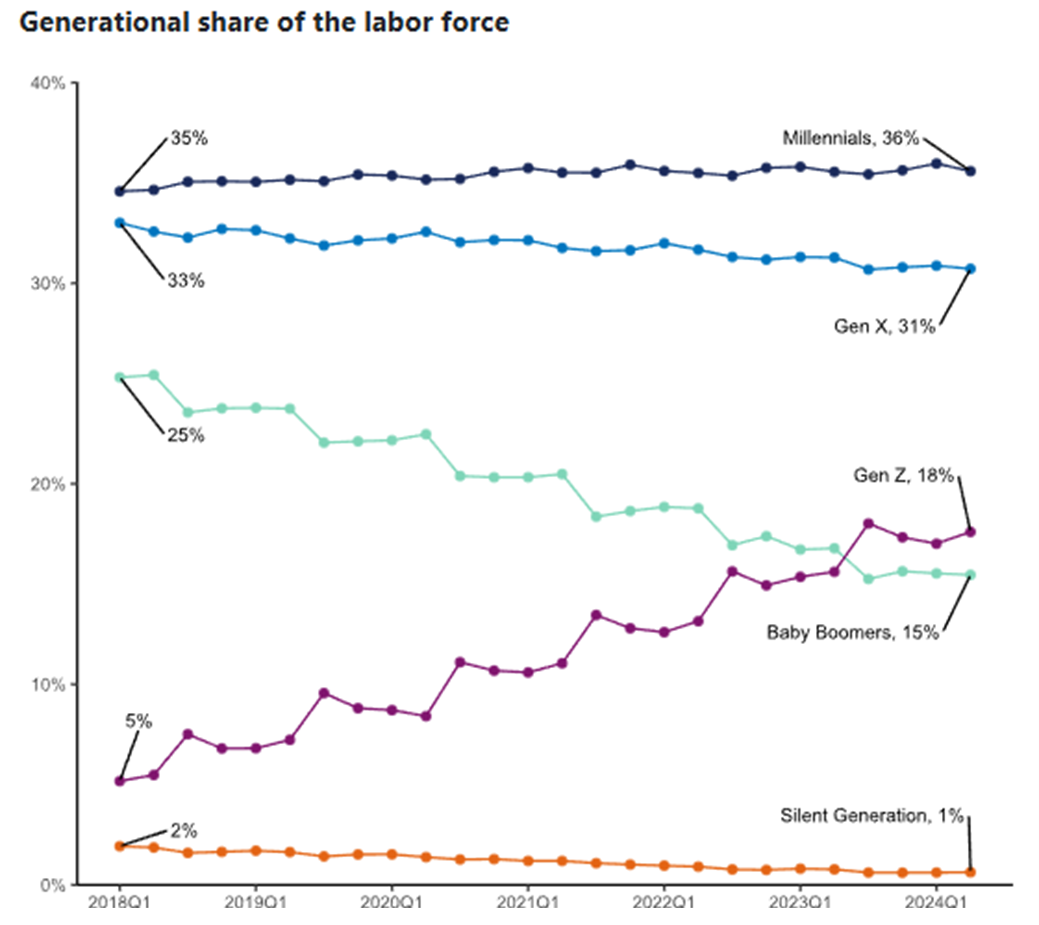
Today’s workforce spans four generations, each with different needs and priorities. Understanding these differences will help you create a benefits package that works for everyone:

Gen Z (ages 26 and under): This group values mental health support and flexible schedules.
Including these benefits can help them stay motivated and engaged.

Millennials (ages 27–42): Many Millennials are focused on paying off student loans and building
financial stability. Programs that support student loan repayment or financial wellness can help
them move toward these goals.

Gen X (ages 43–58): This group is often balancing responsibilities for both children and aging
parents. Flexible schedules and caregiving benefits can help them manage these challenges.

Baby Boomers (ages 59–77): Boomers are focused on preparing for retirement. Retirement
planning resources and preventive health benefits can help them work toward financial security as
they approach this next stage of life.

By offering benefits that align with each generation’s priorities, employers can create a supportive workplace for all employees.

Retirement planning and financial wellness

Retirement benefits are a top priority for both employers and employees. Most companies offer traditional 401(k) plans, and many include matching contributions, which are essential to helping employees save for the future. However, a common gap is access to personalized guidance—only 49% of employers offer retirement planning or investment advice. 3

This is where we can make a difference. We don’t just help you strengthen your plan; we help employees have access to experienced advisors who can help them make informed decisions for their financial future.

A simple plan for better benefits

To help employees get the most out of their benefits, employers can focus on three key areas:

1. Personalization: When employees can choose benefits that fit their unique needs, they feel more
valued. This could include options for health, financial, and family support.

2. Education: Many employees don’t fully understand the benefits available to them. Clear
communication and ongoing support can help them make the best choices for their situation.

3. Whole-person support: Benefits that address mental, physical, financial, and social well-being can
help employees in every area of their lives. This might include programs for mental health,
financial literacy, and caregiving.

Moving forward together

Great benefits can help create a workplace where employees feel supported and motivated. When benefits align with employees' needs, they are more likely to stay and thrive. Whether it’s helping Millennials with financial wellness or supporting Boomers with retirement planning, the right approach can make a lasting impact.

By focusing on thoughtful, well-rounded benefits, employers can build a positive workplace that helps employees work toward their personal and professional goals—while also strengthening the organization.


CURTIS S. FARRELL, CFP®, AIF®
949.455.0300 x222
cfarrell@fmncc.com

ARAN SAHAGUN, CRPS®
949.455.0300 x210
asahagun@fmncc.com

Investment advisory services are offered by Financial Management Network, Inc. (“FMN”) and securities offered through FMN Capital Corporation, (“FMNCC”), member FINRA & SIPC.

This information was developed as a general guide to educate plan sponsors and is not intended as authoritative guidance or tax/legal advice. Each plan has unique requirements, and you should consult your attorney or tax advisor for guidance on your specific situation.

©401(k) Marketing, LLC. All rights reserved. Proprietary and confidential. Do not copy or distribute outside original intent.

Level Up Your Benefits: Your Guide to Student Loan Matching Programs

Student loans can hold your employees back—and their retirement savings too. A student loan matching program can change that.

How a student loan matching program works:

• Employees make their student loan payments.

• Employers match those payments with retirement contributions.

Why it’s a game-changer:

Attract talent: 40% of workers would change jobs for better benefits.

Boost wellness: Help employees pay loans and save for the future.

Stay competitive: Stand out, especially with Millennials and Gen Z.

Starting in 2025, SECURE 2.0 makes it easier to match loan payments with retirement contributions. Is this program right for your team?

CTA: Let’s explore your options


CURTIS S. FARRELL, CFP®, AIF®
949.455.0300 x222
cfarrell@fmncc.com

ARAN SAHAGUN, CRPS®
949.455.0300 x210
asahagun@fmncc.com

Leadership's Role in Benchmarking Retirement and Health Insurance Benefits

Stay competitive, compliant, and cost-effective

Providing competitive benefits is key to building a strong, successful team. Benchmarking is an important tool because it helps you get the data and insights needed to make smart decisions for your benefit plans. It’s also important for meeting rules, avoiding legal trouble, keeping up with industry standards, and supporting your employees.

Here’s why benchmarking should be a priority for your company and how you can use it to improve your plans.

What is ERISA and why it matters

The Employee Retirement Income Security Act (ERISA) sets rules for how employee benefits—like retirement and health plans—are managed. This law requires employers act in the best interests of their employees. Not following ERISA rules can lead to serious legal and financial problems.

With rising healthcare costs putting increased pressure on both employers and employees, managing benefits effectively is more important than ever.

ERISA covers both health and retirement plans, so leaders need to manage both types of benefits responsibly. While health and retirement plans require different reports and documents, the same careful process applies to both. Reviewing plans regularly, getting outside advice, and taking action can help reduce risks, cut costs, and protect employees and your company.

Why benchmarking is important

Benchmarking is the process of comparing your benefits against other companies to see how you measure up.

1. Stay competitive: Benchmarking helps you keep your benefits in line with what other
companies offer, so you can attract and keep top workers.

2. Save money: Studies show that reviewing retirement and health plans can uncover ways to cut
costs, like lowering fees or improving plan designs.

3. Make employees happy: Employees who see real value in their benefits are more loyal and
engaged.

What to look at when benchmarking

To get the most out of benchmarking, you need to look at the right things:

   •  Retirement plans: Check contribution rates, fees, and how investments are performing. Fixing      high fees or replacing poorly performing funds can save money while improving quality.

   •  Health insurance: The average cost for health insurance is over $25,000 per family each year. 1      Reviewing your options can help lower costs without compromising coverage quality. Given the      often-confusing nature of health plan options, benchmarking can help employers navigate      complex choices, streamline benefits, and reduce costs significantly.

Craig Rosenthal, CEO and co-founder of HealthPlanIQ, a thought leader in health insurance benchmarking shares, “Healthcare is too important to myopically focus on fees. Employers and employees need to know that they are getting quality care and achieving positive outcomes for what is by far their largest benefit outlay.”

Keeping plans fair and competitive

Your employee benefits say a lot about your company’s values. Benchmarking helps you balance what employees need with what the company can afford. It leads to better hiring, lower turnover, and a more engaged workforce.

Following your fiduciary duties

ERISA requires employers to act in the best interest of their employees. This means reviewing benefits regularly to catch high costs, outdated options, or other problems. Benchmarking shows you’re serious about following the rules and supporting your employees.

Steps to get started:

1. Get expert help: Work with professionals who know how to benchmark benefits.

2. Compare plans: Use reports to see how your benefits stack up against others.

3. Review regularly: Make benchmarking an annual part of your process.

4. Ask for feedback: Talk to employees about what they like and don’t like about their benefits.

5. Review options: Look for ways to save money without lowering the quality of benefits.

6. Set up a committee: Create a team that meets regularly, takes notes, and makes decisions
based on findings.

Competitive, compliant, and cost-effective employee benefit plans don’t happen by accident: they require thoughtful review and updates. We specialize in helping leaders like you benchmark and optimize 401(k) plans for better outcomes. Let us help you create a retirement plan that works for your employees and your business.


CURTIS S. FARRELL, CFP®, AIF®
949.455.0300 x222
cfarrell@fmncc.com


ARAN SAHAGUN, CRPS®
949.455.0300 x210
asahagun@fmncc.com

Investment advisory services are offered by Financial Management Network, Inc. (“FMN”) and securities offered through FMN Capital Corporation, (“FMNCC”), member FINRA & SIPC.

This information was developed as a general guide to educate plan sponsors and is not intended as authoritative guidance or tax/legal advice. Each plan has unique requirements, and you should consult your attorney or tax advisor for guidance on your specific situation.

©401(k) Marketing, LLC. All rights reserved. Proprietary and confidential. Do not copy or distribute outside original intent.

7 Tips to Help Participants with Long-Term Saving

Improving retirement outcomes means keeping participants focused on the long-term.

Helping employees focus on long-term savings is not easy, especially during uncertain times. Still, employers have seen success. Despite stubborn inflation, a recent survey reports that plan participation and saving rates have reached all-time highs. 1

This is great news, but it’s only part of the solution. Many employees join a retirement plan without fully understanding its purpose. Without such an understanding, they may struggle to stay on track during market volatility, save less than they need, or even cash out early. On the other hand, employees who feel financially secure are 74% more likely to stay with their employer and tend to be more productive. 2

To get the most out of your benefits package, regular communication and targeted education are key. After all, your retirement plan should inspire a loyal and engaged workforce.

Raise awareness about the benefits of long-term savings

Sharing the value of long-term saving is a game changer. Regular communication helps employees feel informed. This can lead to higher participation and greater satisfaction with their benefits. 3

Want to boost awareness? Try these simple strategies:

• Hosting education sessions. In-person or virtual sessions are a great way to engage employees.
Use these sessions to explain the benefits of saving through the plan. Highlight features like tax
savings, compound interest, and building a more secure financial future. Also, address common
concerns like investment risks, market volatility, and setting retirement goals.

• Workplace communications. Regular communication helps keep savings top of mind. Effective
communications may include monthly emails, articles in a company newsletter, or posters in public
areas. Adding charts, pictures, or videos can make the message clearer and more engaging.

Retirement saving topics that resonate

No matter how you choose to communicate with employees, the message matters most. Think carefully about the information you’ll share. Every plan has distinct demographics, and each group has specific interests. A few education and communications themes to consider this year include:

Start saving early. One of the most important ways employees can improve their retirement
readiness is by saving enough along the way. That means starting early. Charts are a great way
to show just how big a difference it can make.

Make the most of your peak earnings years. For many employees, peak earning years (usually,
ages 40 to 60) are an ideal time to focus on retirement savings. With higher incomes, they have
the opportunity to save more and work toward their financial goals. They might consider
increasing plan deferrals, making after-tax contributions (if available), or saving in taxable
accounts. Taking steps during this time can help them better prepare for the future.

Put the power of compound interest to work. Compounding happens when the interest you
earn starts earning interest too. It can be a powerful tool for participants who may not be able
to save as much as they would like to save in the plan.

   •  Stay calm when markets are volatile. Keeping a long-term perspective when markets are volatile      is not easy. Trading activity in retirement plans tends to rise when markets fall. For example, in     August 2024, U.S. stocks experienced a brief downturn, including the worst performance day in     nearly two years.4 Trading activity in 401(k) plans rose to eight times its normal level. Participants     fled to safety, pulling money from stock funds and moving it into stable value bonds, and money     market funds.5 Remind plan participants that stock market volatility is normal. Stocks move higher     and lower; however, over the long term, historically, they have trended higher.

   •  Boost savings with catch-up contributions. Make sure employees understand how much they can      save in your workplace retirement plan. In 2025, the limit for traditional and Roth contributions to      401(k) plans is $23,500. However, older participants who save the maximum amount can make      additional catch-up contributions. In 2025, catch-up contributions are $7,500 for participants      who are ages 50 to 59 or 64 or older. Participants ages 60 to 63 can make “super” catch-up      contributions this year of $11,250. 6

Looking for resources to support employee education and communication? Contact us—we’re here to help! We can help you create campaigns that support long-term success for your workforce.


CURTIS S. FARRELL, CFP®, AIF®
949.455.0300 x222
cfarrell@fmncc.com

ARAN SAHAGUN, CRPS®
949.455.0300 x210
asahagun@fmncc.com

Investment advisory services are offered by Financial Management Network, Inc. (“FMN”) and securities offered through FMN Capital Corporation, (“FMNCC”), member FINRA & SIPC.

This information was developed as a general guide to educate plan sponsors and is not intended as authoritative guidance or tax/legal advice. Each plan has unique requirements, and you should consult your attorney or tax advisor for guidance on your specific situation.

©401(k) Marketing, LLC. All rights reserved. Proprietary and confidential. Do not copy or distribute outside original intent.

Employee Education: Budgeting and Saving

Take Control of Your Finances with Our On-Demand Webinar and Budgeting Worksheet

Managing money can feel overwhelming, but it doesn’t have to be. This on-demand webinar and budgeting worksheet are here to help! This educational toolkit is designed to give you the confidence to budget, save, and plan for the future.

CTA: Watch the Video

What the webinar covers

Why budgeting matters: Discover where your money is going and take charge of your finances.

Debt strategies: Find out how to pay down debt while still saving for what’s important.

Goal setting made simple: Plan for emergencies, vacations, and retirement with ease.

To support what you learn in the webinar, our budgeting worksheet uses the popular 50/30/20 rule. It’s a simple way to organize your income and prioritize your spending.

Here’s how the worksheet helps:

Review your finances: Track your income, review expenses, and visualize your spending with
easy-to-read graphs.

Organize your money: Sort your spending into categories like Needs, Wants, and Savings.

Track your progress: See how your spending compares to the 50/30/20 rule.

Get helpful tips: See suggestions to help you stay on track and adjust your budget.

Paired with our webinar, it’s a great way to build smart money habits.

CTA: Download the Worksheet

Benefits of Financial Education

For employees: Better planning leads to less stress, more focus, and increased financial
confidence.

For employers: Financially-educated teams are happier, more engaged, and better prepared
for the future.

Supporting teams with ongoing education builds morale and engagement. Contact us to explore ways to keep employees connected with valuable resources


CURTIS S. FARRELL, CFP®, AIF®
949.455.0300 x222
cfarrell@fmncc.com

ARAN SAHAGUN, CRPS®
949.455.0300 x210
asahagun@fmncc.com

Investment advisory services are offered by Financial Management Network, Inc. (“FMN”) and securities offered through FMN Capital Corporation, (“FMNCC”), member FINRA & SIPC.

This material was created for educational and informational purposes only and is not intended as ERISA, tax, legal, or investment advice. If you are seeking investment advice specific to your needs, such advice services must be obtained on your own separate from this educational material.

©401(k) Marketing, LLC. All rights reserved. Proprietary and confidential. Do not copy or distribute outside original intent.

Plan Sponsor Newsletter: Retirement Leadership Insights

Wondering how to help your 401(k) plan and committee succeed? Explore our Retirement Leadership Insights newsletter: it covers simple ways to keep your plan on track.

What does a 401(k) committee do?
A committee’s work shapes the success of your plan! Read about what they focus on.

Tips for smooth committee transitions
New members on the committee? Keep things running smoothly with these tips.

Should you consider auto-features?
Auto-enrollment and auto-escalation help employees save—automatically! But they’re not for everyone.

Read the Full Newsletter


CURTIS S. FARRELL, CFP®, AIF®
949.455.0300 x222
cfarrell@fmncc.com

ARAN SAHAGUN, CRPS®
949.455.0300 x210
asahagun@fmncc.com

Investment advisory services are offered by Financial Management Network, Inc. (“FMN”) and securities offered through FMN Capital Corporation, (“FMNCC”), member FINRA & SIPC. 

This information was developed as a general guide to educate plan sponsors and is not intended as authoritative guidance or tax/legal advice. Each plan has unique requirements, and you should consult your attorney or tax advisor for guidance on your specific situation.

©401(k) Marketing, LLC. All rights reserved. Proprietary and confidential. Do not copy or distribute outside original intent.